Sunday, September 29, 2013

The Strathbogie Regiment

I finally finished the Strathbogie Regiment a couple of weeks ago, but a work trip to Canada and a heavy week of preparation for the trip have prevented me from holding a proper photoshoot until today.


The figures are all Perry Miniatures from the Scots of the Civil War and English Civil War ranges. Several of the figures have been converted from English troops to Scots by clipping/carving off the English head gear and addition of Scots bonnets with green stuff. This is an easy conversion and gives much more variety if painting a large Scots army, especially useful for command models.


The unit is modelled advancing into action at Auldearn and, within the constraints of available models, is based on the two-page illustration of the Strathbogie regiment by Gerry Embleton which can be found in the Osprey book "Auldearn 1645 - The Marquis of Montrose's Scottish Campaign" by Stuart Reid.


The regiment is clothed in hodden grey with many troopers wearing tartan breeks or shouldered plaids. This adds a bit of colour and a highland look, and distinguishes the regiment from the grey ranks of the government troops. Headgear is the ubiquitous blue bunnet with the exception of a couple of troopers with monmouth (woolly) caps and a sergeant with floppy hat. I did promise a step-by-step on painting the plaids and will try and get round to that next. 


The flags are based on a description of a set of colours ordered by Huntly in early 1644. The text and device is described by Spalding but the field colour is speculative. I have used yellow for a company colour as yellow is a most suitable field for a rampant lion. I have reproduced the same colour in white for a Colonel's colour. I have also followed Spalding and given the regiment black neck scarves.


"Upon Monday the 15th of April he [Huntley] returned about six hours at even to Aberdeen he caused make some ensigns where upon ilk side was drawn a red rampant lion having a crown of gold above his head a 'CR' for Charles Rex having the motto 'For God the king and against all traitors' and beneath 'God save the king'. There were diverse others made for the barons. The marquis and his followers wore a black taffeta about their craig whilk was a sign to fight to the death but it proved otherwise"

An excerpt from "THE HISTORY OF THE TROUBLES AND MEMORABLE TRANSACTIONS IN SCOTLAND DURING THE REIGN OF CHARLES I" By JOHN SPALDING, COMMISSARY CLERK ABERDEEN


For it's "I've come east and I've come west
And I've come through Strathbogie-oh
And the bonniest lady that ere I saw
She was followin three gypsy laddies oh"

Excerpt from the Lyrics to "The Gypsy Laddie" (trad.)

Strathbogie is the ancient name for the modern burgh of Huntly in the Northeast of Scotland. It was the principle seat of the Marquis of Huntly who raised this infantry regiment first in 1639 and again in 1644 and in 1645 for the King's service. In 1639 the regiment took the field with the Royalist Army at Megray Hill and defended the Bridge of Dee to Montrose's Covenanter force. The regiment was re-raised in 1644 and garrisoned Aberdeen for the Royalists. In October 1644 a small detachment of the Strathbogie Regt. was present at Fyvie with Montrose, but deserted before being engaged. 


In February 1645, following Montrose's victory over Argyll at Inverlochy, Lord Gordon, Huntly's eldest son, defected to the Royalists bringing the Gordon Cavalry, and the Strathbogie Regt was raised on a permanent basis. The regiment then fought with Montrose at Auldearn, Alford and Kilsyth. The unit avoided destruction at Philiphaugh as the Gordon's had left Montrose after Kilsyth due to a quarrel. The Gordon's continued to fight on for the King and the Strathbogie Regt took part in Gordon's  infamous Storming of Aberdeen in May of 1646.

The regiment numbered around 500 men at Auldearn and was armed as regular pike and shot. They performed well for Montrose throughout 1645 and are generally considered well trained and disciplined.


I am dedicating this regiment to my Dad who passed away this summer. My dad got me hooked on local history at a young age and was my companion on many visits to Northeast castles and battlefields including the spectacular Huntly Castle, home of the Marquis of Huntly.


The next regiment on the painting table is Farquharson of Monaltrie's Royalist Regiment. This unit will have two command stands to allow it to do double duty as the Earl of Sutherland's Government Regiment.

Goodbye Dad

It's been a rough summer. In mid June I received the phone call that I had always dreaded. My dad had been feeling poorly for a few weeks and, after being admitted to hospital in Aberdeen, was diagnosed with a very rare and terminal illness. The doctors gave him 2 weeks, and Dad passed away on July 5th with his family by his side. He was 73 years old and had only retired from work 6 weeks before he was diagnosed.


My dad and my son on Castle Hill at Auldearn, July 2008
While growing up in the Northeast of Scotland my dad had encouraged my interest in Scottish history and regularly took me and my sister to local castles, battlefields and stone circles and taught us the history of these places. These childhood outings inspired a life long love of history and throughout my adult life my, despite living overseas, every time I was back in Scotland my dad and I continued to visit these places together.

My dad and my sister at Alford Battlefield, April 2013
The last thing I did with my dad before he took ill was a walk along the River Don at Alford Battlefield in late April. In the days following the funeral I walked several of the places we would visit together including Fyvie Castle and battlefield, the Braes of Gicht and the Hill of Dunnideer in the shadow of Bennachie. Goodbye Dad, you will be missed.

Walter Morrison, 1940-2013


Saturday, September 7, 2013

Auldearn - the Musical!

Following on from the last post on religious intolerance - now some misogyny too.

The last witch to be killed in Scotland was Isobel Goudie, in 1662.

She lived in Auldearn, daughter of a solicitor. As a girl she witnessed the battle, perhaps the horrors she saw on that day affected her. There's lots of stuff out on the net if anyone is interested in reading further.

Makes me think we will need to have her on the board with some of the local worthies - maybe with a cat...

Meanwhile, here's the much lamented Alex Harvey with a wee tune.

Sunday, July 28, 2013

Covenanter Command - For Kirk & Kingdom

Scotland is one of the best examples of how organized religion really f@#k's you up.  If I had a pound for every person who's been screwed over by the kirk or chapel in Scotland, I'd be a rich man.  John Knox unleashed the genie the century before, and the Civil War in Scotland was more about the "Good Book" (and misinterpretation thereof) than about anything else.

The covenanter's and their relationship to both King, the Church of Scotland and the Scottish Parliament is a long and complex story.  However, the Kirk's religious commissars have a large part in the blame of the deterioration of the Scottish Army's performance through the Civil Wars.  Kilsyth, Dunbar etc., all came crashing down mainly due to these guys holding the upper hand at key moments.

So to that end one of these small minded, religious zealots had to make an appearance in the force.  What better place than on a command base, hectoring the troops.  Here, the Paster Jack Glass, from Dalmarnock, shouting "The Beast is coming! Down with the Pope in Rome" and other less savoury epithets.


Saturday, July 27, 2013

Command Base

Still trying to get the focal length down on the new camera, so some issues here.  

Really enjoy putting together these vignettes, can get a narrative going with only a wee bit of thought.

Lighting not to good indoors but hot as hell and rainey here in H-town at the moment! 


Monday, July 22, 2013

Earl of Seaforth's Regiment

One of the biggest of the northern clans, George Mackenzies power extended from the Moray Firth to the island of Lewis.  He played both sides during the war, raising and disbanding his men reflecting the fluctuations of local success or presence of large armies.  After Inverlochy, Mackenzie was captured by Montrose and signed the Kilcumin Bond, promising to raise his troops for the king and capture Inverness.  However, with Hurry active around the town, the Mackenzies, Maclennan’s and Macauley’s of Lewis took the field on the government side.
 
At Auldearn the regiment suffered heavily.  Clan MacLennan (and MacRea's and Matheson's),  the "Banner men of Kintail", who acted as the standard party of the regiment suffered heavily.  The Clan stood its ground, fighting around the Clan standard of the Mackenzies, the "Caber Feidh", until the fell with their chieftain Ruairidh Mac Gille Fhinnein. However, even with so much slaughter, Mackenzie scrambled to reach an accommodation with Montrose, and settled the remains of his regiment on the lands of his erstwhile ally, Lord Lovat’s Frasers.
 
Again, Mackenzie prevaricated, and held back from accompanying Montrose south. However, after Philliphaugh when Montrose returned north he renewed the Kilcumin Bond (for which he was excommunicated from the Kirk).  Eventually, as Middleton brought the covenanter army into the north, he eventually surrendered and travelled to Edinburgh where he repented at St Giles.  By late 1646, Mackenzie and his Lairds had received full pardons.

 These troops where Clan MacLennan (and MacRea's and Matheson's),  the "Banner men of Kintail", who acted as the standard party of the regiment.  The Clan stood its ground, fighting around the Clan standard of the Mackenzies, the "Caber Feidh", until the fell with their chieftain Ruairidh Mac Gille Fhinnein.

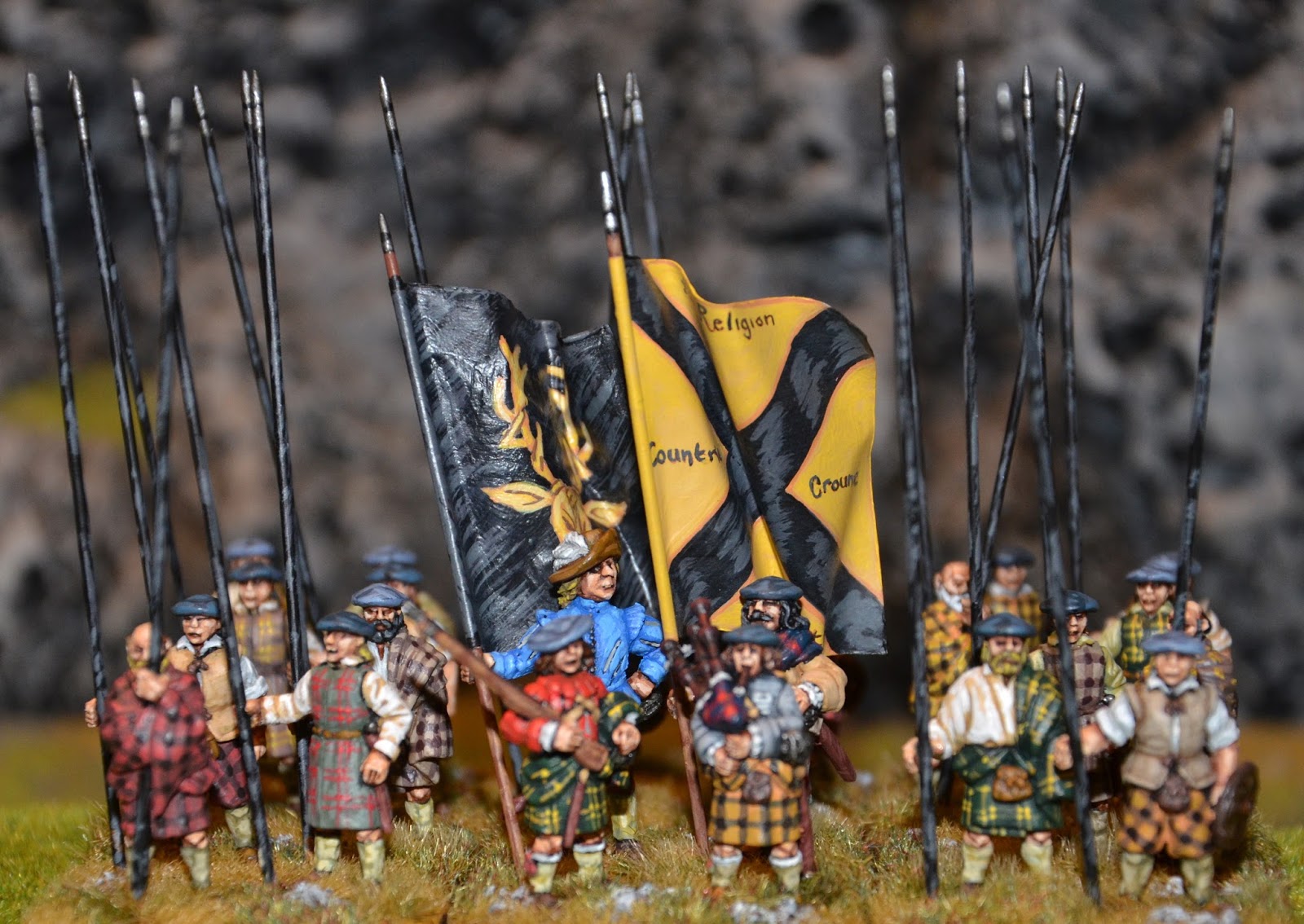
Not a lot of evidence to go on with regards colour scheme and certainly no romanticised tartan set to unite the regiment. However, the Caber Feidh or Stag Horn standard gave me the opportunity to paint the Mackenzie clan crest.  The yellow/gold on black colour scheme made the choice of a contrasting black on yellow saltire, but again with no historical credance.

The tartans were, in the local parlance, "murder" to paint, resulting in this regiment seemingly taking forever.  Mixing up the colour schemes certainly had a lot to do with it, as did the change in patterns.

The figures are all Eureka, with the command coming from modified MacColla & Montrose figures.  Targe's were added from Old Glory, for some close in work and to add a little more variety.  Some of the troops are bow armed which was recorded as being used in the battle - so they presumably shoot over the heads of Lawer's and the Lord Chanceller's who were in the thick of it at the front.

I'm pretty happy with how they turned out but glad that I'm not doing it again!

Project Auldearn is now almost at an end for me with regards painting.  Buchannan's regiment should be out soon, with some command bases for good measure.  Will also likely do Lothian's regulars to help Walter shift his side of the mountain.

The end is in sight!!!