Saturday, February 28, 2015

Terrain IV

Spent the last couple of meetings dry-brushing the terrain and making it come to life.  The grass took a couple of "lightening-up's" to really come out - the roads, having a bit more obvious texture, jumped out straight away.

Again, the light is problematic as can be seen in the shots below - all taken within about 3 minutes of each other.

We thought hard about how to represent the marshy areas which played such an important part in the battle, eventually just doing some washes and bespoke dry-brushing. - think it came out better than it may appear in the shots.


Detail around Castle Hill showing the texture that the toweling brings.


Based up some trees - mix of Woodland Scenic types and old GW.  CD's and steel washers provide the bases, allowing a little more stability.  All the exposed bark was painted - got away from the plastic sheen.

Had hoped to buy some rubberized horsehair ones but couldn't find a good supplier here in the states.


Monday, February 23, 2015

Terrain Building III

Spent most of yesterday painting the towels to get a consistent finish - the dying having been a bit hit and miss.  All the fabric types blend pretty well - next stage is the dry brushing

Getting the roads on was also done - nice contrast with the green.

Amazing how the colors change depending on the light/angle...


Monday, February 16, 2015

Terrain Building II

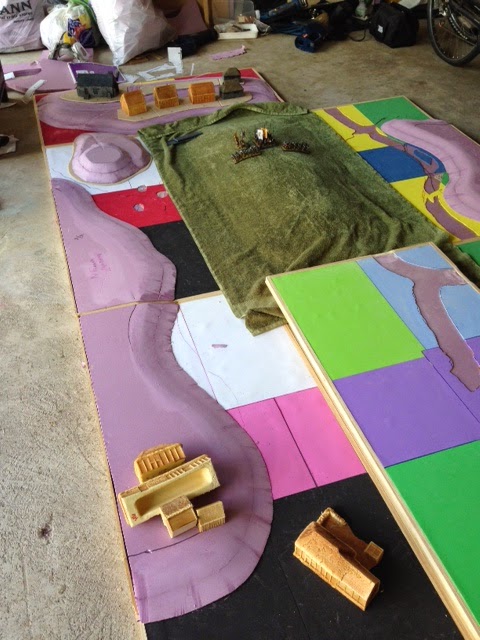
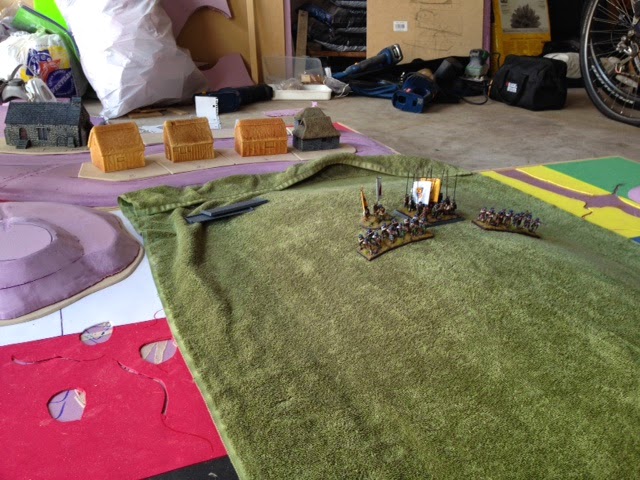
Started the business of "dressing the boards this weekend.Rather than grass-mat or painted sand, we chose to use toweling dyed olive green (mostly), using Dylon dyes.  As no two batches are exactly the same (different dilutions, amounts of salt used to fix colours) we ended up with a variety of tones.


These shots look down the board to Auldearn village, showing Garlic Hill in the centre and Castle Hill off to the flank. Still got some gaps to fill in and the roads to paint and texture.


The towel was stuck down with a mix of wood-glue and plaster of paris, but we need to fix some of the edges, then saturate the whole thing with watered down pva for extra strength.  This should also give us a better texture to dry brush the towel, breaking down the hard edges.


Castle Hill is the only lay down terrain on the board all the other hills are intrinsic - helps stop warping.


Good view "up-table" showing the layout of the village


Some Covenanters and Macollas Lifeguard fro scale


Detailed shot giving a feel for the texture on Garlic Hill.


With most pike and shotte regiments having a foot of frontage - even big features such as this will get cluttered fairly quickly.


View from the defenders side.


Wednesday, February 11, 2015

Terrain Building I

The last couple of weeks have been spent building the boards for the battlefield.  We have a hard deadline on this part of the project for if we want to get it into the next WSS article (due out in May) - we need the photographs out by the end of February.

We decided that we'd build enough boards to cover 6' by 24' - as this would give us plenty of variety going forward - with the Auldearn Board (6'by 8') being the main aim. This meant we had a lot of work to do.

The basic design would utilise 2' by 4' mdfs, and we buildt beading around the edges, fitting 1/2inch foam insulation into the center - so we got strength with lightness.

The terrain was then outlines and height build up by adding more sheets of foam


Auldearn Village - basic design


Auldearn Village - hill sculpt - note additional thin sheets of foam added to level up 1/2 inch insulation foam.


Garlic Hill - center point of the battle - 2" of hill built up


It was essential the slopes were gentle enough that the figures were standing reasonably vertically - so we couldn't build up to much height.


We have through hard about cladding the boards and think a variety of dyed toweling and some limited grass mat will give a good effect - this is pretty similar to the stuff on the Perry's site - which has been a great inspiration.


Boards looking pretty big - this shows relationship of Garlic Hill, Castle Hill and Auldearn Village


Detail of "clad" Garlic Hill with Monymore's Regiment guarding the crest.

The houses have all been painted, each will have its own small tile with fencing etc.

We only have a little sanding on some other hills and painting of the board edges before we get down to the dressing phase - hopefully it should be done this weekend......


Monday, January 12, 2015

Dragoon Gun Line

Happy New Year - looking forward to big things this year as we put Project Auldearn all together!

Here's a couple of photos of the complete Covenanter Dragoons - mounted reserve, horse holders and skirmishing Dragoons.

I'm really pleased how these all turned out - I remember trying to get it straight in my head, then planning it through.

Looking forward to getting it all out on the table!


Friday, December 19, 2014

Hugh Frasers Dragoons

Originally a dragoon regiment, by the end of its career, the troopers had become hardened enough (and perhaps with sturdier nags) to become traditional cavalry.  Its recruiting area under Hugh Fraser of Kynneries is unknown. All of its senior officers where veterans from the continent.

Arriving in England in May, by the siege of York it was well provisioned and with an impressive compliment of troopers.  Serving with Leven through Northumberland and County Durham it acquitted itself well at the Battle of Corbridge.  When Montrose, before his Highland adventures, attacked Morpeth castle, Fraser and Wheldons Horse pushed the royalist back.

At Marston Moor, they deployed on the allied left, pushing forward to take control of the Sike Beck, a ditch perpendicular to the main deployment. As both forces began to deploy, some of Ruperts' cavalry pushed forward into contact with Frasers Dragoons. They held and prevailed, with the royalist troopers fleeing to York.  

As Cromwell advanced, the dragoons cleared the ditch in front of the main body of horse, allowing the allied line to charge unimpeded.  After briefly resting, the regiment moved forward again in support of the calvalry.

Newcastles' Whitecoats had positioned themselves within the enclosures at White Sikes Close, determined to sell themselves dearly.  Both Cromwell and Leslies Horse had been unable to make an impression, so Fraser's dragoons were moved up.

Firing into the hedgehog of pikes, a gap was made, which their mounted colleaques exploited, breaking then routing the Whitecoats, cementing the allied victory at Marston Moor.

Over the following months, throughout the winter, it crossed and recrossed the Pennines, serving at the siege of Carlisle.

By summer, Montroses' success in Scotland led it being recalled by Leslie to move north.  On September 13th, it was engaged at Philiphaugh, ending Montrose's advance.  However, as the north was still in arms, it moved north with Middletons cavalry.  By October, it received permission to become a regiment of horse and returned to England.

By now, the long campaign and lack of supply/pay began to take its toll.  It continually levied retribution on the area's it was quartered in - running what amounted to little more than extortion on the locals.  Relations soured not only with the local populace but with the constabulary and with the Parliamentary army - who demanded the miscreants be tried under their jurisdiction.  The Scottish officers refused, having held their own court martials.

By the spring of 1647 the regiment left England to be disbanded at Kelso.  Fraser received a commission in the "New Model" army, but although it had an excellent reputation, in England it was forever associated with the depredations of the original.